What is AMT?
AMT (Akkadia Main Token) is the core utility token used in Akkadia’s live environment.
AMT is not a “reward token.” It is the token that carries the costs, responsibilities, and permissions required for Akkadia to persist and expand as an on-chain world. For the overall context, see the token overview. If you are looking for the early-phase contribution layer, see ACR.
The Role of AMT
In Akkadia, a world is not a simple game session.
Worlds are created, data is stored, blocks and contracts are invoked, and user creations are reused.
All of this happens on top of an on-chain structure.
AMT is the medium that represents the cost, responsibility, and permission required for that structure to operate. In other words, AMT is the token that keeps the world alive.
AMT in the Token Lifecycle
AMT is introduced after stabilization, in the live phase. During the test and early phase, only ACR is used.
Akkadia’s token structure continues as a phased lifecycle:
- Early phase
- ACR is active
- Participation and contribution are recorded
- Live phase
- AMT is introduced
- World maintenance, utility execution, and the creator economy become active
- Bridge
- ACR → AMT conversion can connect early contributions to the live ecosystem
Core Concept: World as an On-chain Structure
Akkadia’s worlds are not instances that are deleted or reset; they are on-chain structures that are stored and maintained.
Therefore:
- Data has cost
- Functionality requires responsibility
- Creations need rules for ownership and usage
AMT is the unified medium used to express these concepts clearly.
Where AMT Is Used
1. Special Blocks
Persistent Data & Responsibility
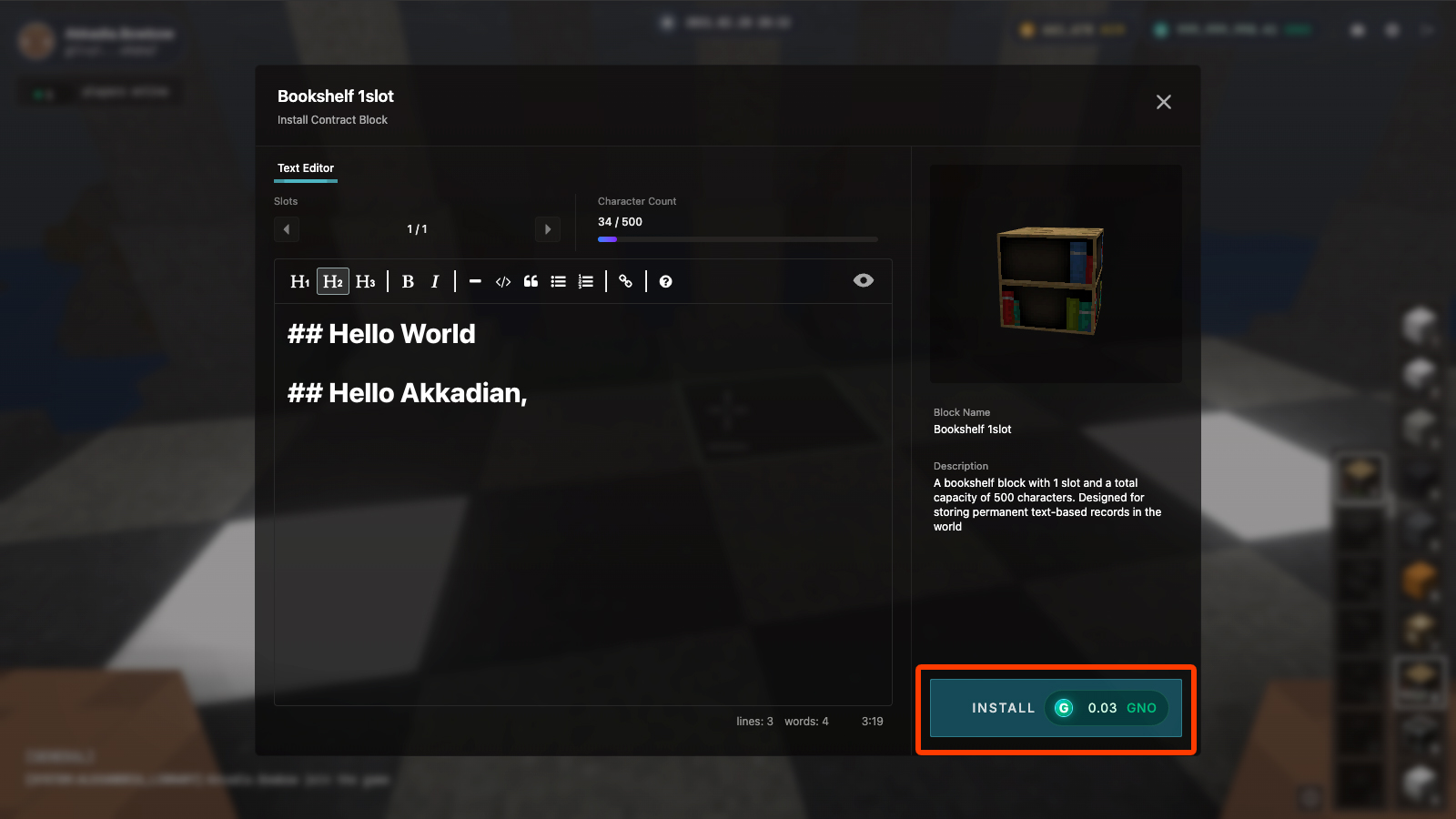
Special blocks power core functionality in Akkadia.
- Blocks that maintain persistent state
- System blocks that affect world structure
- Functional blocks that influence other blocks and gameplay flow
Unlike ordinary blocks, these require permanent on-chain storage costs.
AMT is how those costs are paid, and it is not merely a usage fee; it is a mechanism that explicitly assigns responsibility for the persisted data.
2. User-created Custom Blocks
Creation Becomes Economy
AMT elevates user creation into protocol-level economic activity.
Example: Portal Block
- A user spends AMT to create a portal based on a contract block
- The portal is defined as a custom block
- Other users need AMT to place or use that portal block
- AMT spent on usage is paid to the portal’s original creator
This enables:
- Creators to leave functionality inside the world
- Users to reuse proven functionality
- Akkadia to grow a self-expanding ecosystem of functionality without centralized control
3. Equipment
Expression, Not Power
AMT does not aim for a Play-to-Earn model that directly amplifies combat power or profit.
Instead, equipment focuses on:
- Appearance customization
- Playstyle choices
- Different ways to explore
These are domains of expression and choice.
This design aims to avoid widening player gaps and instead encourages each player to experience the world in their own way.
4. Consumables
Expanding the Experience
Consumables are not designed as repetitive revenue tools; they are support tools that enrich the play experience.
- Items that assist exploration
- Tools that expand world interaction
- Functional items useful in specific situations
AMT is used to create and use these items, providing convenience and variety without harming the game’s flow.
AMT Flow (Conceptual)
AMT is designed around a conceptual flow:
-
Consumption
storage costs, utility usage, block and item creation -
Circulation
circulation via usage of blocks, utilities, and items between users -
Preservation
long-term preservation of worlds and data
This structure prioritizes sustainable world operation over short-term rewards.
AMT vs ACR
| Token | Purpose | Phase |
|---|---|---|
| ACR | Contribution record | Test / Stabilization |
| AMT | World operation | Live / Production |
- ACR is a record of participation
- AMT is a means of operation
AMT does not replace ACR; ACR is the layer that holds early-phase contribution before AMT.
Tokenomics Notice
Detailed AMT tokenomics (total supply, distribution, conversion ratio, etc.) will be disclosed after system stabilization and the game structure are finalized.
Akkadia defines how the token is actually used before publishing numerical parameters.
Summary
- AMT is the main token used in Akkadia’s live environment.
- AMT carries the costs and responsibilities required for worlds and data to persist.
- User creation becomes economy through AMT.
- AMT prioritizes world maintenance and expansion over speculation.
AMT is central to making Akkadia a sustainable on-chain space, not a temporary game.